
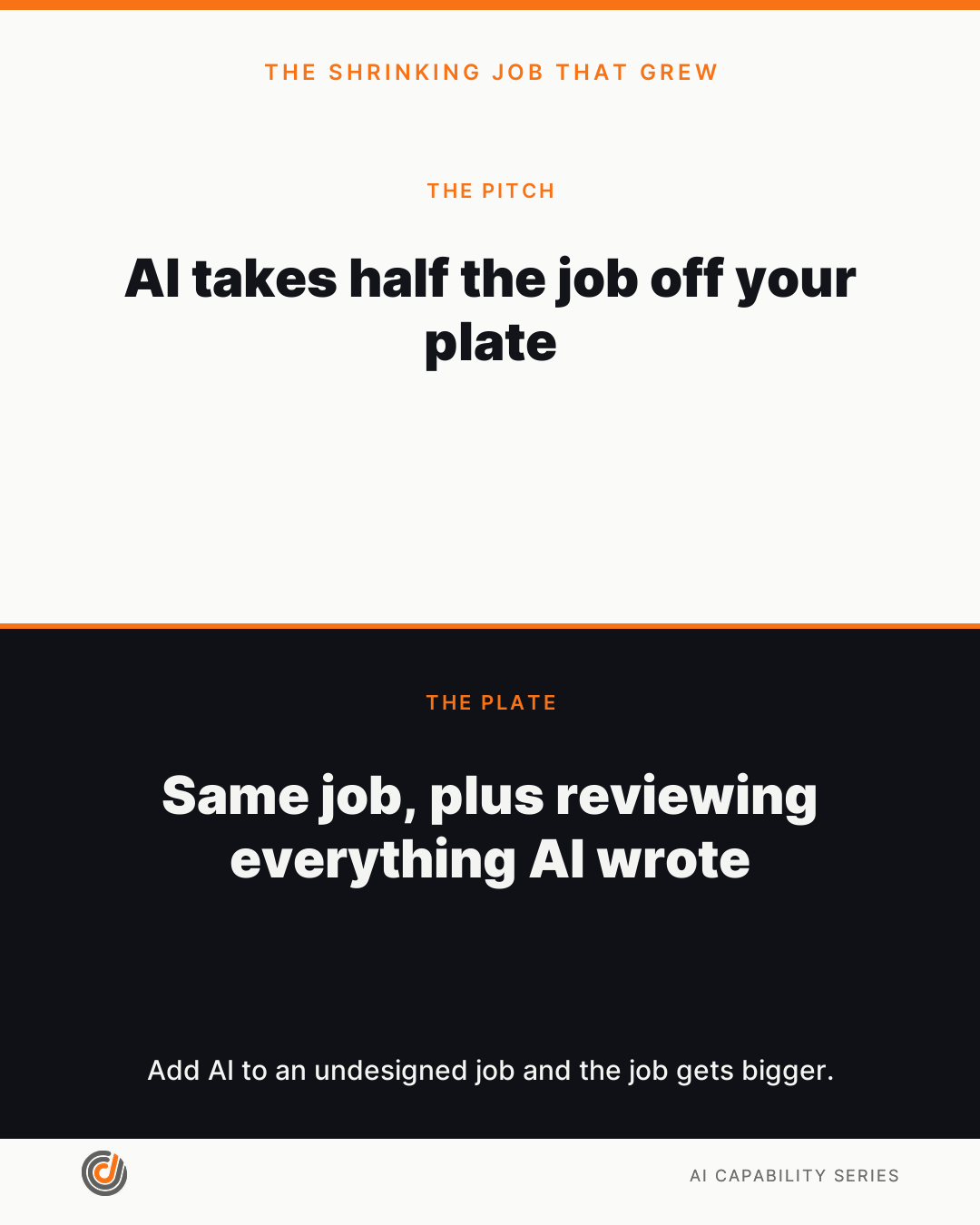
AI Made The Job Bigger
Everyone expected AI to shrink work. Inside real companies the job is getting bigger, because nobody redesigned the role the tool landed in.
The promise was fewer hours. AI would take the grunt work, the job would shrink, and you would get part of your week back. Inside real companies, the opposite is happening: the job is quietly getting bigger.
Gleb Tsipursky put it plainly in HR Daily Advisor this month: "AI expands the job before it eliminates the job." The tool arrives, the role stays the same, and suddenly the role holds more. His second line belongs above every rollout plan: "AI shortens the first draft. It does not remove accountability." The draft got faster. Everything around the draft stayed exactly where it was: the review, the judgement, the ownership of what ships. He argues HR should treat AI as a job-architecture event, not a software rollout. Almost nobody does.
You can watch what happens instead. UC Berkeley researchers spent eight months inside a 200-person U.S. tech firm and ran 40 in-depth interviews, published in Harvard Business Review and covered by Fortune. Nobody was told to hit new targets. "People just started doing more because the tools made more feel doable." Work bled into breaks and evenings. People used their breaks to prompt AI instead of resting. Product managers started writing code. Designers started doing data analysis. One worker said it straight: "you don't work less. You just work the same amount or even more."
Two failures, one omission
When capability lands on a role nobody redesigned, one of two things happens.
The first is what Berkeley documented. People absorb it. The job swells to fill the new capacity, and it keeps swelling, because "doable" has no ceiling. Nobody decided this. It just accumulates until someone breaks or leaves.
The second is what TechCrunch is tracking: a running list of 2026 layoffs where the employer name-checked AI. Leadership sees the same strain, reads it as slack, and cuts the lower rungs. Keep the tool, thin the team, assume the maths holds.
These look like opposite responses. They are the same mistake. A licence adds capability to a role. It does not change the role. So the new capability piles on top of the existing job, and someone has to decide what leaves the job to make room. In both failures, nobody made that decision. Nobody redesigned the work.
We know redesign is where the value sits, because someone measured it. Kim, Kim and Koning ran a controlled field experiment with 515 high-growth startups in a three-month accelerator. The group that redesigned its end-to-end workflows around AI generated 90% more total revenue than the control group. Same funding, same skills, same tools. The control group mainly used AI to speed up individual tasks. The redesign group also needed roughly 40% less external capital. The tool was identical on both sides of the experiment. The redesign was the difference. The value was never in the tool.
One thing to do this week
This needs no budget line. Take one role on your team. Yours, if you like.
First, list what AI now actually does in that role. Write it down: first drafts, meeting summaries, code scaffolding, data pulls, translations. Be honest about how much of the old job that covers.
Then cut one thing the human used to do. Reassign it or stop it outright. Not "streamline" it. Remove it from the job. The instinct will be to bank the freed hour back into more output, and that instinct is exactly what the Berkeley firm did by accident: same headcount, same roles, more work, less rest.
The test is simple. If you can name one thing that person no longer does, you have started redesigning the job. If you can't, you haven't redesigned anything. You've just made the job heavier.
Sources
See where your organisation actually stands.
The free VERIFY capability scan scores you across the six moves in ten minutes.
Get the playbook