
Meta Wants Its Managers Back
Meta bet AI would remove management work; now it is asking its own AI division to manage again, because AI creates that work.
Three years ago Meta decided it had too many managers. In 2023, the "year of efficiency", it asked many managers and directors to become individual contributors or leave. In May this year it cut around 10% of its workforce, roughly 8,000 people, and the layoffs fell disproportionately on managers. It also scrapped plans to fill 6,000 open roles. The bet, in Fortune's words, was that AI would shrink its management ranks.
Now Meta is asking people to become managers again. Quietly, and in the one division it built to accelerate its AI ambitions.
What Meta is doing
Fortune reported last week that Meta has begun asking individual contributors in its Applied AI division whether they would volunteer to "transition back into manager roles". That division, AAI, was created this year and staffed with roughly 7,000 reassigned employees, some of them former managers. Its teams were reportedly designed flat, with up to 50 individual contributors per manager.
Be fair to Meta here. Business Insider, citing four people familiar with the programme, says it is voluntary and does not appear to signal a company-wide return to the old management model. It is a reversal inside one division. But it is the division that matters most for this argument, because it is the one Meta designed around AI. Fortune's own conclusion: building and deploying AI at scale "still requires human leadership, coordination, and oversight."
Where the work goes
This is the part the flattening bet got wrong. The bet assumes AI removes coordination work. The evidence says AI relocates it.
Trinity College Dublin released "Right-Sizing AI at Work" on 10 September. Led by Taha Yasseri and commissioned by Technology Ireland DIGITAL Skillnet, it finds employees taking on more responsibility for "reviewing, verifying, coordinating and exercising judgment" over AI-supported outputs. Read that list again. Reviewing. Verifying. Coordinating. Judging. That is a job description for a manager.
Yasseri's summary: AI's impact is "best understood as a process of task and workflow transformation rather than immediate large-scale job displacement." The report also finds that 47.4% of workers use AI daily and 69% feel prepared to adapt, while participation in formal training lags well behind that confidence. And one line worth pinning above your desk: "using AI and generating real business value from AI are two very different things."
Harvard Business Review made the same point from the other side in August. Hoque, Davenport and Scade argue that many layoff announcements are "ordinary restructuring initiatives packaged in AI language to reassure investors", and that "we are much earlier in the process than the prevailing narrative suggests". They cite a Goldman Sachs estimate that AI reduced monthly US payroll growth by only around 16,000 jobs over the past year. By that measure the jobs are mostly still there. The work inside them has changed shape.
A span of fifty is a span of nobody
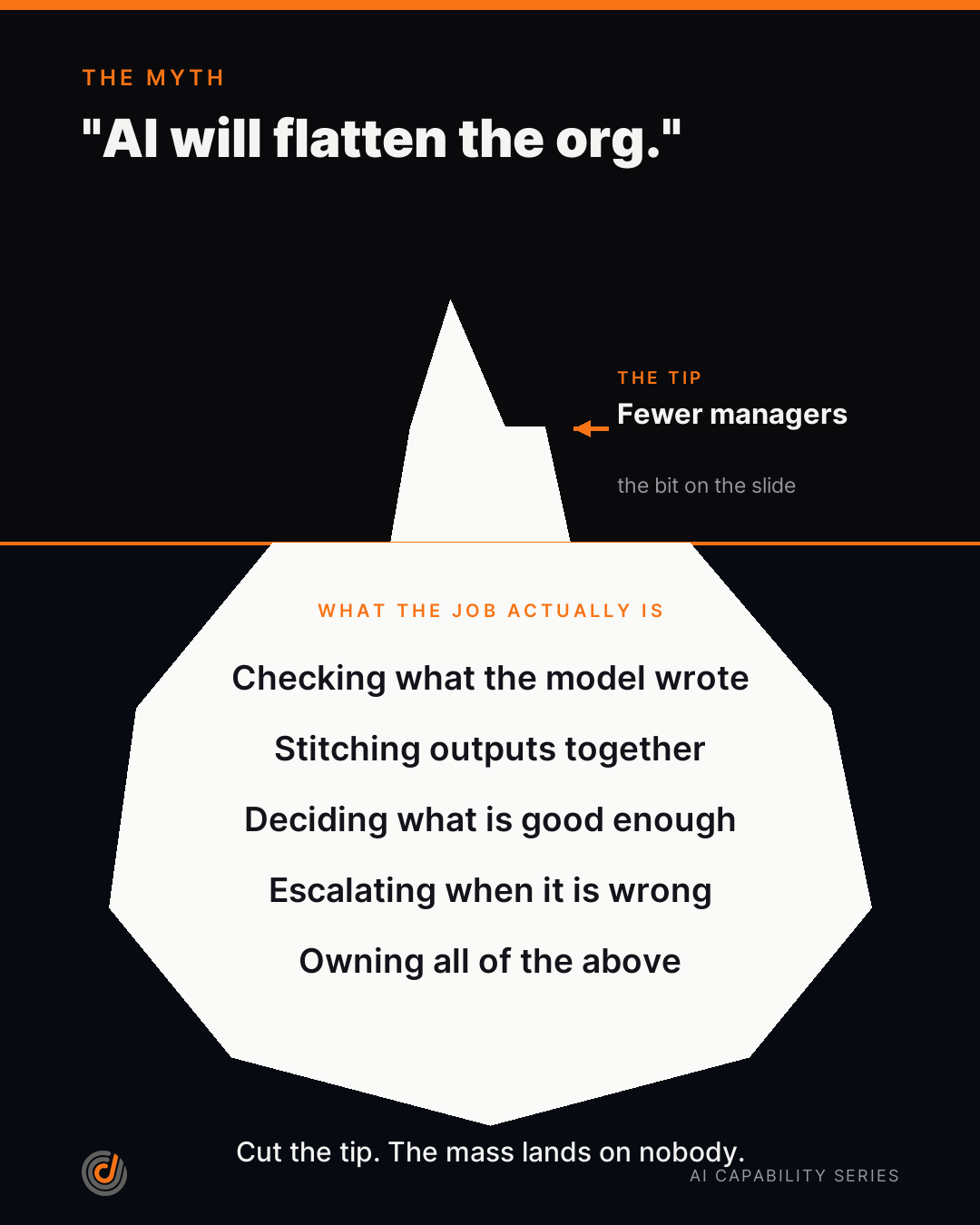
Put the two together. AI adds a layer of work: someone has to check the output, stitch four half-finished drafts into one thing, decide whether it is good enough to send, notice when it is wrong in a way the author cannot see, and escalate when it is. In a normal organisation, deciding what is good enough and who does what next is management work. It has a name and a person attached.
Now give that person fifty reports. They cannot do it. So the work lands on the individual contributors, unnamed, on top of the work they were hired for. Or it lands on nobody, and the first you hear of it is a bad output that reached a customer. Delayering on the promise of AI does not remove coordination. It removes the only role that was accountable for it, at the exact moment AI is generating more of it.
That is why Meta's move stings. The company that argued loudest for flat is the company now asking, inside its own AI division, who will manage. Whatever its internal reasons, the lesson on offer is plain: verification and judgment do not run themselves.
One thing to do this week
You do not need a reorg to find out whether you have the same gap. Take one team that uses AI heavily. Sit with them for an hour and list every review, coordination or judgment task that AI has added to their week in the last month. Checking a generated summary before it goes to a director. Reconciling two outputs that disagree. Deciding whether a drafted answer to a citizen is safe to send. Escalating a citation that turns out not to exist.
Then write two things next to each task: who actually does it, and whether it appears anywhere in that person's role description or their allocated time. Most lists come back with several tasks that someone does every day and nobody owns on paper.
That column of unowned tasks is your real org chart gap. It is more accurate than the one on the slide. And it tells you what a manager in your organisation is now for, whether or not you still call them one.
Sources
Your move
See where your organisation actually stands.
The free VERIFY capability scan scores you across the six moves in ten minutes.
Get the playbook