
The Coaching Job Nobody Funded
Your AI budget buys seats; the actual skill-building happens in a manager's unpaid, uncounted hour. Fund the hour, not the licence.
Somewhere in your organisation, a manager spent an hour yesterday checking a document an AI produced in four minutes. That hour shows up nowhere: not in the adoption dashboard, not in the training records, not in anyone's objectives. The dashboard shows seats activated. The manager shows up tired.
Here is the claim I want to defend: AI capability is built, or quietly lost, in the middle-manager layer. Not in the training room. Not in the C-suite. The real unit of adoption is the team, and a team's ability to use AI well is made by one person: the manager who validates the output, catches the errors, and coaches the people producing them.
The evidence got a lot sharper last month. Julia Shin and Sandra Sucher interviewed partners, managers and junior consultants at two major consulting firms for HBR: 18 interviews, tracking how each level actually used AI. Their finding is blunt. "Most organizations treat AI adoption as a technology challenge—a software rollout to be managed by IT and celebrated by the C-suite." What they found underneath the rollout was middle managers silently absorbing a new job: verifying AI output before it reaches clients, catching errors juniors can no longer see, teaching people when to trust the machine and when not to. All of it on top of unchanged delivery targets, with no support structures. Some organisations, the authors note, even see AI as a fast track to headcount reduction, aimed at exactly the layer doing this work.
Gallup put a number on what that layer is worth. In the State of the Global Workplace 2026, employees whose manager actively supports their AI use are more than twice as likely to use it frequently. Only about 30% of employees say they have such a manager. And manager engagement itself has dropped sharply, hardest in organisations that are flattening structures and cutting management roles. Read those three findings together. The strongest known multiplier of AI use is manager support. Seven in ten employees don't have it. And the people who could provide it are being thinned out.
One more piece. In April, researchers ran a field experiment with 388 employees at a Fortune 500 retailer. Everyone got identical AI software. Only the framing of the work varied. Where people were pushed through a mandatory behavioural protocol (structured paired procedures, imposed from above), document quality went down and output dropped hard. Where AI was framed as a thought partner, quality rose at the top of the distribution. Same tool. Different framing, different results. And framing how a team works is not an IT deliverable or a training module. It is a management act.
Buy the hour, not the seat
Now the organisational consequence, because this is where budgets go wrong. Your AI spend is built around things procurement can count: licences, seats, training hours, completion rates. But everything above says the skill grows through something none of those line items touch: manager attention. The hour reviewing a junior's prompts. The ten minutes explaining why the AI's confident answer was wrong. The judgment call about which tasks the AI touches at all.
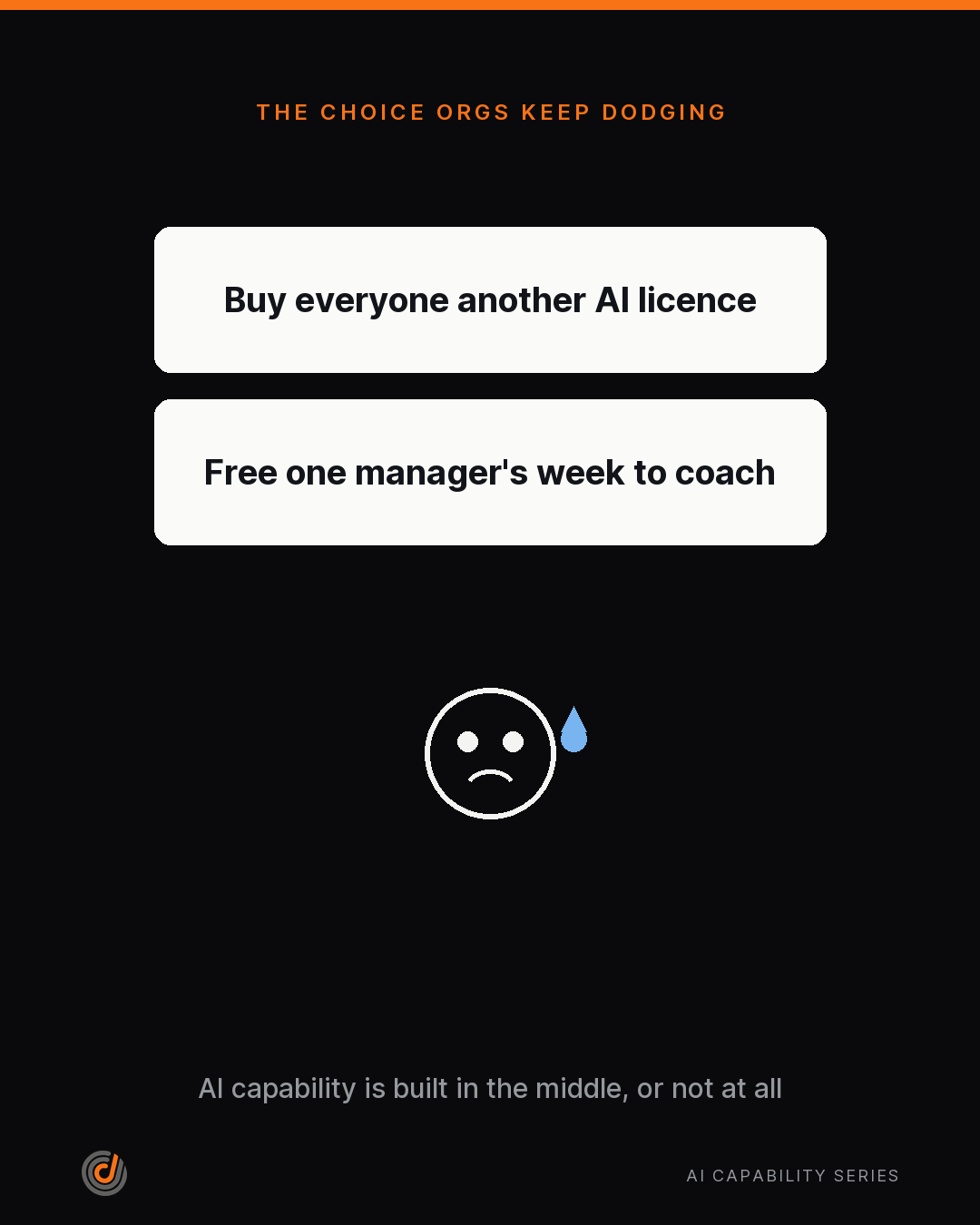
So the budget logic has to flip. If team-level AI competence is made by managers, your AI budget should buy manager time and coaching space before it buys another seat. Reduce a delivery target. Take one recurring deliverable off a manager's plate and name the freed hour as review-and-coaching time. Make "my team uses AI well" an explicit, recognised part of the manager's job instead of an invisible tax on it. If the manager has no hour to coach, no volume of licences will build anything underneath them. You will get usage statistics and unexamined risk.
The bitter version: many organisations are running the opposite play. Buying seats at scale, cutting the management layer to fund them, then wondering why the pilots don't spread. The HBR interviews and the Gallup numbers describe the same machine from two sides. The role that converts AI spend into AI competence is the role being loaded and starved at the same time.
One thing you can do this week, and it needs no budget line. Ask three managers to keep a plain tally for five working days: every hour spent checking, correcting or coaching AI-assisted work. Then bring the total to your next leadership meeting and put it next to the licence count. Most organisations know their seat numbers to the decimal and have nothing on this. Once that hidden hour has a number, it can be planned, recognised and paid for. Until then, your most important adoption work is being done for free, by people you may be about to cut.
Sources
See where your organisation actually stands.
The free VERIFY capability scan scores you across the six moves in ten minutes.
Get the playbook