
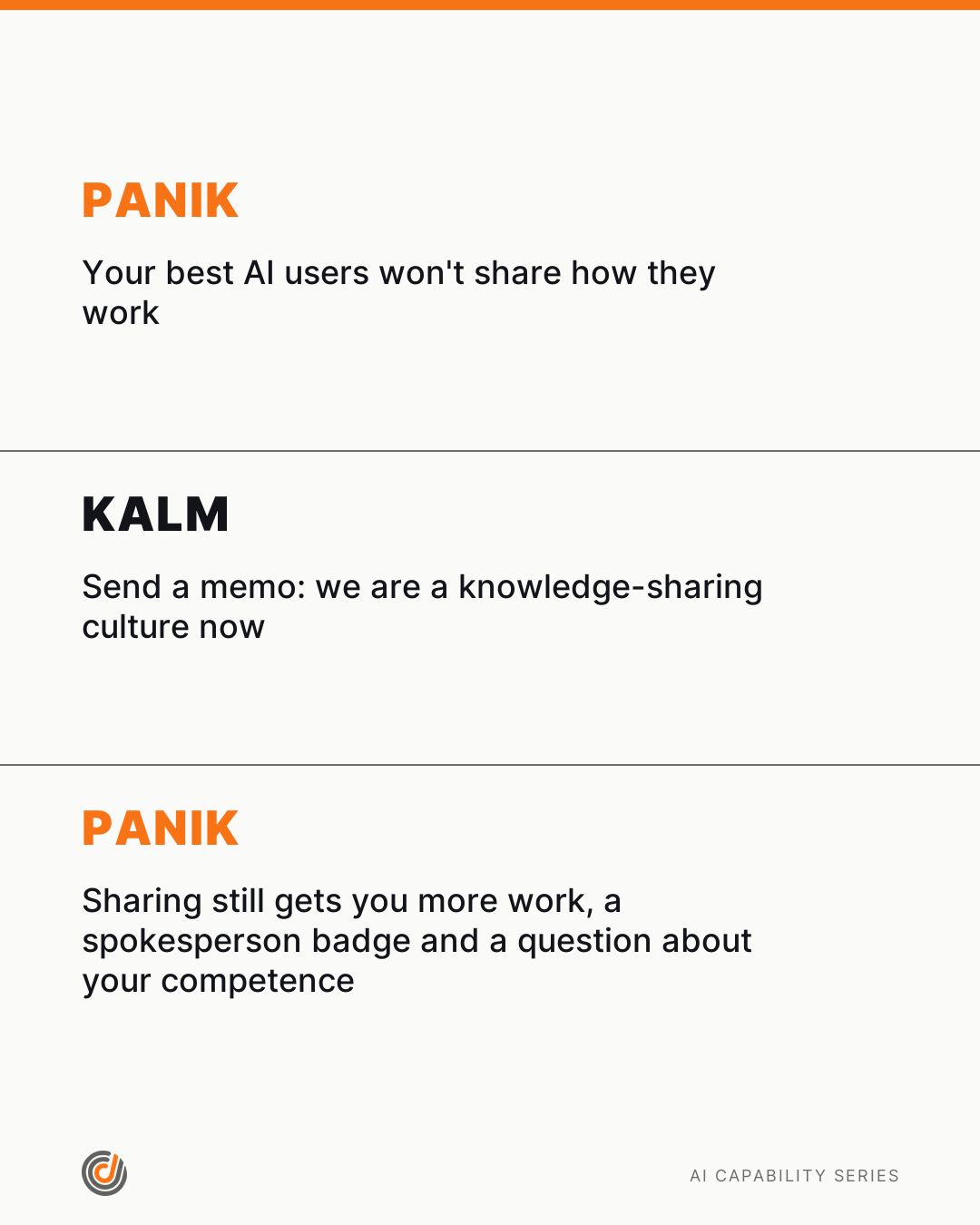
Your Best AI Users Are Hiding Their Methods
Nearly one in three frequent AI users hide their methods from colleagues for rational reasons, and the fix is leadership behaviour, not another training programme.
Somewhere in your organisation, someone has probably found a much faster way to do their job with AI. They have not told anyone. On the evidence, that is the sensible choice.
One in three, and they know better
Eric Anicich and Jeslyn Brouwers at USC Marshall surveyed 604 US employees who use AI at work daily or several times a week. Nearly one in three had withheld "AI-related knowledge, workflows, or techniques from coworkers or employers". Four in five believed sharing would benefit their team. People know the team would gain. A third of them hide their methods anyway.
The dividing line was not skill or seniority. Anicich: "What separated the sharers from the hoarders was trust in the organization." The gap is large: "People in the bottom quarter on trust were about four times as likely to have withheld something as people in the top quarter."
The reasons people gave read like a price list. Reputation: using AI makes you look less competent. Workload: you get more tasks, or you become the company's unpaid AI spokesperson. Job security: you have just shown that the technology could do your job. Each one is a cost the organisation attaches to disclosure. None of them is a knowledge gap, so no course closes it.
Overriding the AI is the same move
Das Narayandas at Harvard Business School describes the mirror image in Why Your Employees Override AI. Employees override systems that demonstrably work, and they do it out of self-protection rather than resistance. His example: a global bank piloted an AI credit-approval system that was faster and more accurate. Six months after rollout, humans still made most of the decisions.
His explanation fits in one sentence: "When accountability remains personal, people will take steps to protect themselves." If the system is right and you approved it, nobody notices. If the system is wrong and you approved it, your name is on the file. So you override, quietly, the same way your colleague hoards, quietly.
These are not two problems. Hoarding and overriding are one behaviour: keeping career risk manageable in an organisation that has not decided who carries it. Narayandas puts four questions to leadership. Who loses discretion if the system works? Who gains authority, and over which decisions? Who explains outcomes when the system is followed? Who absorbs transition risk during the learning curve? Leave them unanswered and individuals answer them for you, by protecting their turf. As he puts it, "Full adoption will occur only when approving a system's decisions does not feel like a professional self-sacrifice."
There is a quieter tell. Jayshree Seth and Amy Edmondson open their piece on AI and psychological safety with an anonymous email: an AI-generated for-and-against analysis of a proposed regional expansion, sent to leadership with no explanation. When people route even their dissent through a machine, you have your safety reading.
You are paying for capability you cannot see
Your adoption dashboard counts licences and logins. It cannot count methods. The capability you actually need, the working method that makes one person twice as fast, exists in your building and is private property. Anicich again: "If your best analyst is fast because of a method nobody has seen, you don't really know what you're paying for."
You cannot redesign a workflow you cannot see. You cannot coach a method into the next person while its owner keeps quiet, and you cannot redefine a role around it. So the training programme goes ahead and teaches people a job that has already changed under them, in ways nobody will describe out loud. Most capability building sits downstream of a disclosure problem nobody has noticed.
A memo will not fix it. Brouwers is direct about this: announcing "we are now a culture where we share knowledge" is "a very different story" from showing it. What does move is the price of disclosure. The USC recommendations are concrete: reward adoption in performance reviews, give protected time to experiment, share the productivity gains with the people who produce them, and do all of it without turning anyone into a technology advocate. That last clause is the workload cost, and it is the one well-meaning managers get wrong. Asking the person who just shared to now run a session for everyone is a penalty, not a reward.
Answer Narayandas's four questions in writing. Then change what it costs to show your work. Both are leadership decisions. Neither has a licence fee.
This week, no budget line
A manager goes first. In your next team meeting, show your own AI method. Show one that failed as well, because a method that only ever worked teaches nobody much and signals that failure is still expensive here. Then say out loud what sharing will not cost in this team: no extra work, no spokesperson role, and credit in the review for whoever shows theirs. Then ask one person to bring theirs next week.
Trust moves when the person with the most cover carries the risk first. Until someone does, your best users will keep doing the rational thing, and you will keep paying for a method nobody has seen.
Sources
See where your organisation actually stands.
The free VERIFY capability scan scores you across the six moves in ten minutes.
Get the playbook