
Your Heaviest AI Users Can't Change Anything
New enterprise AI data shows your most intensive users are your most junior people, which is exactly why all that usage produces so little redesign.
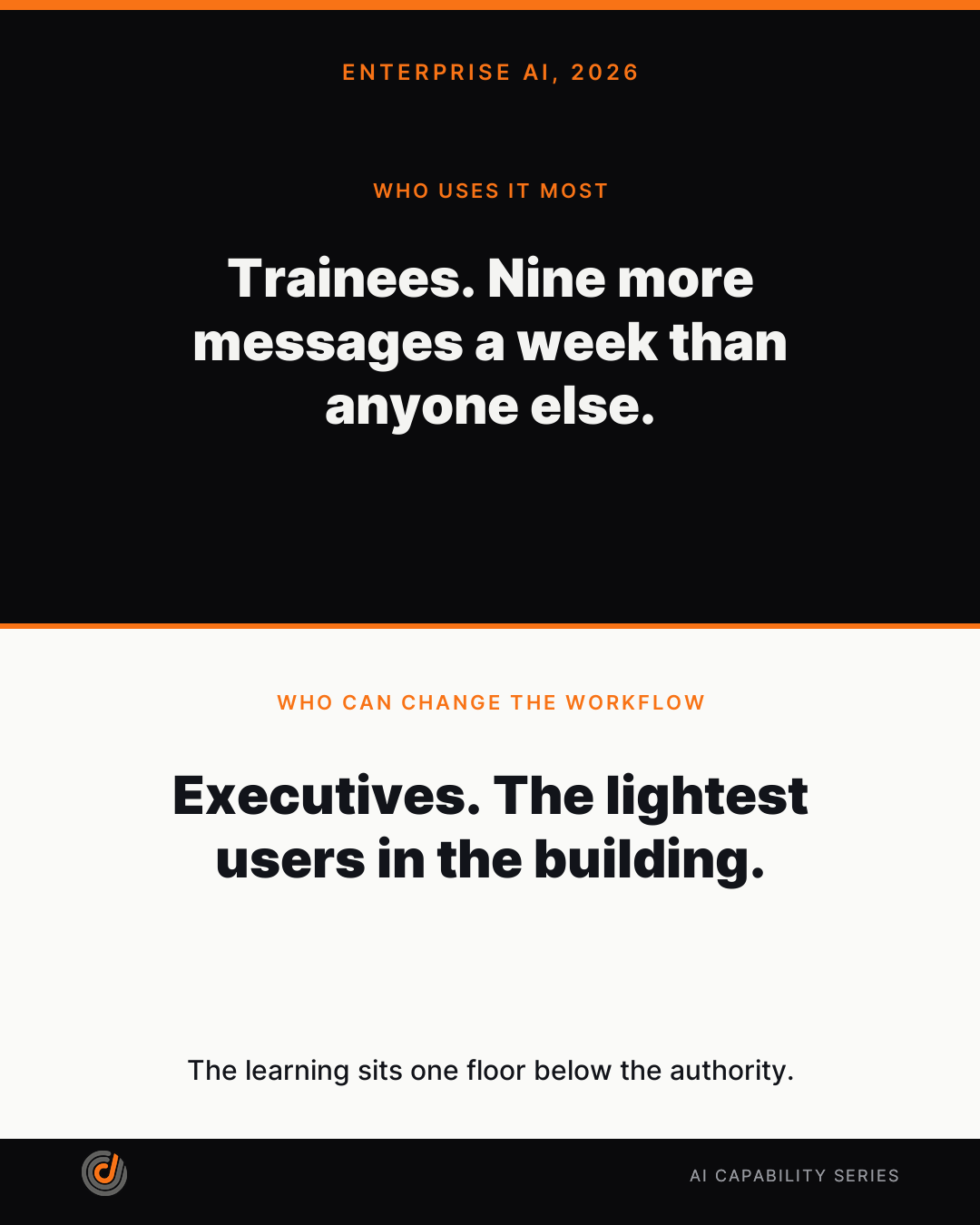
The people using AI most intensively in your organisation are the ones with the least authority to change how work is done. The people who could actually redesign a process are barely touching the tools. Everything you are frustrated about, the pilots that stall, the usage that never becomes redesign, lives in that gap.
This is no longer a hunch. Aaron Chatterji, David Holtz, Neel Rakholia, Prasanna Tambe and Gawesha Weeratunga, researchers from OpenAI, Columbia Business School and Wharton, have published a working paper linking ChatGPT Enterprise account records to actual usage: over 17 million messages from 1,764 organisations, covering adoptions from January 2024 to March 2026. The finding that matters is a strong negative seniority gradient. In their words: "early-career workers and trainees send roughly eight to nine more weekly messages than the average active user within the same firm, while managers, directors, and executives send fewer messages."
Read that again. The more junior you are, the more you use AI. The more senior you are, the less.
Where the learning goes
Why does this matter? Because the authors are clear that firms are nowhere near done figuring this out. They write that "firms are learning where it belongs in their organizational workflow" and that "adoption is only the beginning of deployment." Organisations, they find, "differ widely in the speed, breadth and purpose of their enterprise AI adoption, and ... they are still actively learning how to integrate AI into organizational workflows."
So there is learning happening. Thousands of hours of it, every week, inside your own firm. Someone is discovering exactly where the tool breaks in your intake process, which handover it could remove, which review step it makes pointless. But that knowledge is accumulating at the level of the organisation that cannot change an intake process, remove a handover, or kill a review step. Meanwhile the people who can are making platform decisions, governance decisions and workforce decisions about a tool they have almost no felt experience of. They are deciding from the deck, not the desk.
The honest objection: some of this gradient is just the shape of the work. The same study finds that more than half of active users perform documentation or technical-writing tasks, and drafting-heavy work sits lower in the hierarchy. Fair. But that reading changes nothing about the consequence. Whatever the cause, the outcome is the same: the felt knowledge of what AI actually does to a workflow, and the authority to act on that knowledge, sit in different people. Skills programmes do not close that gap. Licence rollouts widen it, because they push usage further down while decisions stay up.
What closing the gap looks like
Warner Bros. Discovery gives us a rare picture of the alternative. In a case study for MIT Sloan Management Review, George Westerman and David Kiron describe an initiative led by Rebecca Kent, Head of Transformation, working with Matt Chun, EVP of Corporate Strategy. Deliberately business-led, not technology-led. And the sequence is the point: executive alignment came first, and it came through use. Leaders worked hands-on through complete marketing case studies with the tools themselves before any pilot was selected. Workshops across business units surfaced roughly 100 use cases, primarily to build trust with the workforce. Legal looked for "paths to yes instead of blocks." Governance was "focused on action rather than prevention." They went after "the 80% in the middle," and Kent refused the cost-cutting frame outright: "As a media company, we didn't want to go out there with any idea that we want to save money."
Notice what hands-on leadership buys you. Kent can say, honestly: "The tools haven't borne out as fast as I originally thought...the tech moving fast but perhaps not as fast in the areas we need." A leader who has done the work can tell you precisely where it disappoints. A leader whose experience of AI is a usage dashboard can only repeat what the vendor told them.
One thing to do this week
You do not need a budget line for this. You need a room.
- Pick one process owner. Someone who can actually change a workflow, not someone who reports on it.
- Find the heaviest AI user on their team. Your admin data will tell you. It is probably someone junior.
- Book ninety minutes. The senior person does one complete, real piece of their own work with AI, end to end. Not a demo, not a prompt tips session. The junior person coaches.
You have just moved felt experience up the hierarchy and given craft knowledge a direct line to authority. That is capability building. Everything else is watching a dashboard.
Your usage numbers are not measuring adoption. They are measuring who in your organisation has permission to learn and no permission to act.
Sources
See where your organisation actually stands.
The free VERIFY capability scan scores you across the six moves in ten minutes.
Get the playbook